Every AI Agent, Identified. Authorized. Inspected. Governed.
AI-FW sits between your AI agents and the models they call, blocking jailbreaks, masking PII, enforcing policy, and auditing everything. One gateway for all of it.
Works with the models and tools your teams already use
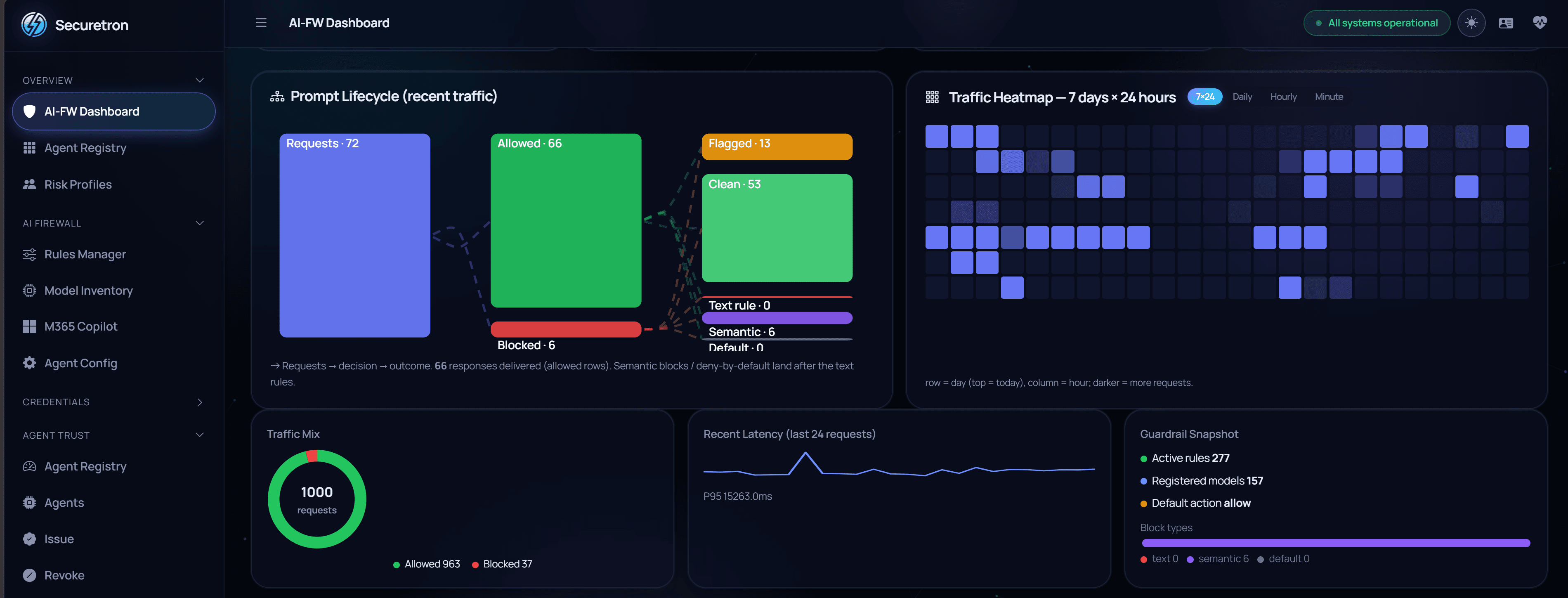
Your whole AI estate, on one dashboard
Live traffic, guardrail decisions, identities, and audit - all in a single operational view built from metadata, never raw content.
Security for AI, without slowing it down
Six capabilities that turn a model API into a governed, auditable, enterprise-grade AI pipeline.
Prompt & response guardrails
Jailbreak and prompt-injection detection, PII masking, toxicity filtering, and data-exfiltration blocking on every request, inbound and outbound.
Semantic intent analysis
Judge the meaning of traffic, not just its text. Score requests against natural-language policies with embeddings, a chat classifier, or a fully offline engine.
Intelligent model routing
Route each request to the right model and backend, with per-model keys, failover, and weighted distribution across providers.
Identity & access
Authenticate agents with API keys, JWT, mTLS, or Kerberos. Enforce roles with RBAC, and connect SSO with OIDC and SCIM provisioning.
Risk & audit
Rolling risk scores per user, agent, and IP, with automatic blocking. Every transaction lands in a metadata-only audit log.
Reliability & caching
Per-model retries, failover, and distribute modes. An exact and semantic completion cache keeps latency down and bills in check.
One pipeline. Four steps.
No agent-side changes. Point your clients at the gateway and the pipeline takes over.
Connect
Point any OpenAI-compatible or Anthropic client at the AI-FW gateway, OpenAI SDKs, Claude Code, Cursor, MCP tools, or plain HTTP.
Inspect
Every prompt and response is scanned in real time: jailbreaks, PII, toxicity, exfiltration, and your own custom rules.
Govern
Semantic intent scoring, per-model routing policies, and risk profiles decide what flows, and what gets blocked before it leaves.
Audit
Metadata-only transaction logs, live dashboards, and audit events give your security team full visibility without storing content.
Pay less per prompt. Expose fewer keys.
Three reasons teams move from direct-to-LLM integrations to a gateway.
- Caching cuts spend. Exact and semantic cache hits re-serve repeated prompts without another upstream call: a first request returns 200 in 0.64 s, an identical second request in 0.0075 s, about 80x faster, with byte-identical bodies. Fewer upstream calls means lower token bills.
- API keys stay server-side. Provider keys are stored in the model registry and injected on forward. Endpoint agents that talk directly to the LLM never need to hold them, shrinking the blast radius if an agent is compromised.
- Compression trims tokens. Semantic-gated prompt compression strips filler before forwarding, meaning never changes, and a rejected gate sends the original. Explore prompt compression.
Know what your AI is doing, and stop what it shouldn't
Shadow AI, risky agents, leaked credentials, policy drift, AI-FW surfaces them all on live dashboards and risk profiles, and can block automatically before anything sensitive leaves the building.
- Metadata-only transaction log, content is never persisted
- Risk auto-block: N violations in a rolling window → cooldown
- Shadow AI discovery for unregistered models
- Audit events for every configuration change
- M365 Copilot admin bridge with agent sync
Transaction feed
Put a firewall in front of your AI
Get the gateway running in minutes. Inspect, route, and audit your first prompt today.